On this page
Delhi NCR tariffs have crossed ₹9 per unit and summer power cuts are back in 2026. Every apartment owner in Gurgaon, Noida, and Delhi is weighing the same decision — install a balcony solar system or upgrade to a bigger inverter with a lithium battery? This is the honest, math-backed comparison, including a 10-year cost breakdown and a decision matrix by flat type.
It is April 2026. Your Gurgaon 3 BHK electricity bill from March just hit ₹9,400. Your neighbour's WhatsApp forward says DHBVN is hiking tariffs again. Last Tuesday, the power tripped for 40 minutes in the middle of a client call because Sector 56 had a transformer overload.
You have two options on the table, and both cost roughly the same upfront:
- Install a balcony solar system — cut your bill by ₹1,500–₹3,000 every month for the next 25 years.
- Upgrade to a bigger inverter with a lithium battery — sleep through power cuts, run the AC during outages, but pay the same (or higher) electricity bill.
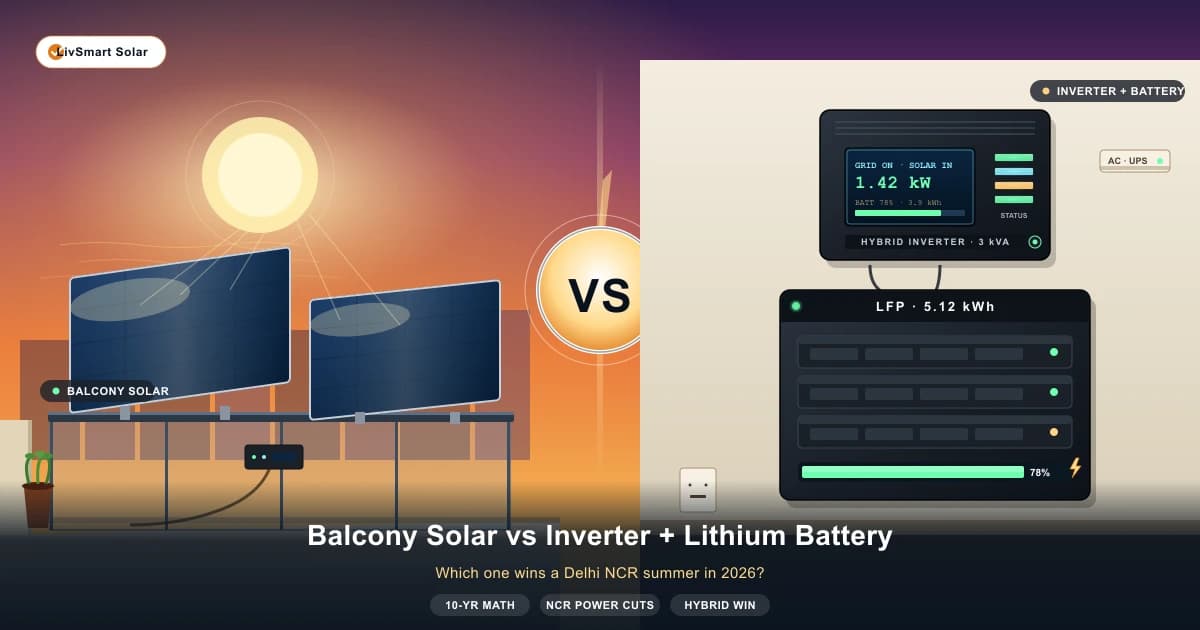
Which one actually wins in Delhi NCR in 2026? The honest answer is: they solve completely different problems. This guide breaks down the math, the real-world performance, and which one is right for your flat.
First — Understand What You Are Actually Buying
This is where most NCR residents get the decision wrong. They compare these two products as if they do the same thing. They do not.
A balcony solar system generates electricity
During the day, panels on your balcony railing convert sunlight into power. That power flows into your distribution board and runs your fridge, fans, Wi-Fi, lights, and one AC — in real time. Your meter spins slower. Your bill shrinks. When the sun goes down, generation stops and you are back on grid power.
It does nothing during a power cut, because plug-and-play micro-inverters have anti-islanding protection — a safety feature that shuts down the panels the instant the grid goes dead (so line workers do not get electrocuted during repairs).
An inverter + battery stores electricity
A modern home inverter with a lithium battery (LFP chemistry, 2–5 kWh) charges from the grid during normal hours and dumps that stored power back into your flat the moment the grid fails. It does not reduce your bill — in fact, it increases it slightly because of charge/discharge losses (typically 10–15%).
It buys you uptime, not savings.
The shortest version of this article: if your pain is the bill, you want solar. If your pain is the power cut, you want a battery. If your pain is both — keep reading.
The Real Cost in Delhi NCR (2026 Prices)
Balcony solar — what you pay, fully installed
| System Size | Covers | Installed Cost | Monthly Generation |
|---|---|---|---|
| 800 W | Lights, fans, fridge, Wi-Fi | ₹45,000–₹55,000 | 96–108 units |
| 1.5 kW | + Partial AC offset | ₹70,000–₹90,000 | 180–204 units |
| 2 kW | + 1 AC for ~4–5 daytime hours | ₹85,000–₹1,10,000 | 240–270 units |
| 3 kW | + Most daytime loads | ₹1,30,000–₹1,70,000 | 360–405 units |
Prices include Tier-1 panels (Longi, Jinko, Trina), a quality micro-inverter, non-penetrating railing mounts, wiring, and commissioning. Most NCR apartments choose 1.5 kW or 2 kW.
Inverter + lithium battery — what you pay, fully installed
| Backup Size | Covers | Installed Cost | Runtime on Battery |
|---|---|---|---|
| 1 kVA / 2 kWh | Lights + 2 fans + Wi-Fi + 1 TV | ₹55,000–₹75,000 | 4–6 hours |
| 2 kVA / 3 kWh | + Fridge + 1 laptop | ₹90,000–₹1,20,000 | 4–5 hours |
| 3 kVA / 5 kWh | + 1 AC for 1–2 hours | ₹1,50,000–₹2,00,000 | 1–2 hours on AC, longer on basic loads |
| 5 kVA / 5 kWh + AVR | + 1.5-ton AC whole-night (stretched) | ₹2,20,000–₹2,80,000 | 3–4 hours on AC |
LFP (lithium iron phosphate) batteries last 8–10 years in NCR climate and carry a typical 6–8 year warranty. Older lead-acid tubular batteries are cheaper (₹35,000–₹60,000 for similar capacity) but only last 3–4 years in Delhi's heat and need water top-ups every quarter — avoid them in 2026 unless budget is extremely tight.
10-Year Total Cost Comparison for a Typical Gurgaon 3 BHK
Let's take a real flat: a 3 BHK in Sector 84 Gurgaon, ₹8,500 average monthly bill, DHBVN tariff of ₹8.50/unit for the 200–400 unit slab, 2–4 power cuts per month averaging 30 minutes each outside of summer, jumping to 6–8 cuts per month of 45–90 minutes in April–June.
Option A: 1.5 kW balcony solar (no battery)
| Year | Cost | Savings | Cumulative |
|---|---|---|---|
| 0 | ₹85,000 | — | –₹85,000 |
| 1 | ₹0 | ₹21,000 | –₹64,000 |
| 4 | ₹0 | ₹22,500 | +₹4,000 (break-even) |
| 10 | ₹0 | ₹28,000 | +₹1,75,000 |
| 25 | Panel warranty expires | Lifetime savings | ₹6.5–₹8 lakhs |
Power cuts? Still annoying. Solar gives you zero backup during outages.
Option B: 3 kVA / 5 kWh lithium inverter battery (no solar)
| Year | Cost | Savings | Cumulative |
|---|---|---|---|
| 0 | ₹1,75,000 | — | –₹1,75,000 |
| 1 | ₹1,500 (service) | ₹0 (bill unchanged, slight increase from losses) | –₹1,76,500 |
| 10 | Battery replaced ~₹1,10,000 | ₹0 | –₹3,00,000+ |
Power cuts? Fully covered. Bill? Unchanged. Net outflow: ₹3 lakh+ over 10 years — the cost of buying uptime.
Option C: The hybrid play — 2 kW balcony solar + 2 kVA / 3 kWh battery
| Year | Cost | Savings + Backup | Cumulative |
|---|---|---|---|
| 0 | ₹1,95,000 | — | –₹1,95,000 |
| 1 | ₹0 | ₹28,000 saved | –₹1,67,000 |
| 7 | Battery replaced ~₹70,000 | ₹30,000/yr saved | –₹50,000 |
| 10 | — | — | Break-even |
| 25 | — | Free electricity + backup | ₹4–₹5 lakhs net positive + outage protection |
The hybrid costs more upfront but is the only option that solves both problems. For most NCR buyers with the budget, this is the winning configuration — see the decision matrix below.
What Actually Happens During an NCR Summer Power Cut
This is the scenario that drives most inverter+battery purchases in Delhi NCR. Let's be specific about what each system does at 3:47 PM on a 46°C Tuesday in May 2026 when BSES trips your feeder.
Scenario: 45-minute outage, 3 BHK, 1.5-ton AC running
With balcony solar only:
- Panels immediately shut down (anti-islanding).
- You lose AC, fridge compressor, fans, Wi-Fi, everything.
- You sit in the heat for 45 minutes.
- When grid returns, solar restarts automatically.
- No harm done, but no comfort either.
With 3 kVA / 5 kWh lithium battery only:
- Zero-millisecond switchover. Your Zoom call does not drop.
- AC continues running — battery discharges fast, gives you 1.5–2 hours on a 1.5-ton AC before cutting off.
- Fridge, lights, fans, Wi-Fi all continue.
- If the cut extends beyond 2 hours, the AC shuts off; basic loads continue for 2–3 more hours.
With hybrid (balcony solar + battery):
- Same zero-ms switchover as battery-only.
- But — the battery is topped up by solar during the day, extending runtime.
- On a sunny afternoon cut, your 3 kWh battery may never actually deplete because panels are producing ~1.5–2 kW in real time.
- You run the AC effectively indefinitely during daytime outages.
Daytime outages are exactly when NCR grids fail most — transformer overloads peak between 1 PM and 5 PM when AC load is highest. This is where hybrid shines most in Gurgaon, Noida Sector 150, and Dwarka.
How Each System Performs Through an NCR Year
Delhi NCR has four distinct seasons, and they affect these systems very differently.
Summer (April–June): 42–46°C
- Balcony solar: Peak generation period. 5.5+ sun hours/day. 1.5 kW system generates 220–250 units/month. You feel every rupee of savings because this is also your highest-bill month.
- Lithium battery: Performs fine up to 50°C ambient. Life reduces slightly in extreme heat. Make sure it is installed in a ventilated utility area, not a sun-facing balcony.
Monsoon (July–September): Heavy rain, dust storms
- Balcony solar: 40–50% dip in generation during heavy monsoon. IP65-rated panels and inverters handle rain fine. Dust storm warning — clean panels after each major storm (10-minute job with a squeegee and water).
- Lithium battery: No impact. This is the season where battery wins most.
Post-monsoon + winter (October–February): Clear skies, short days
- Balcony solar: Generation drops 15–20% due to shorter days, but low dust and clear skies keep efficiency high. Net generation only slightly below annual average.
- Lithium battery: Winter power cuts are less frequent in NCR; battery sees light usage. Good for charging-cycle longevity.
Pre-monsoon (March): Dust + heat starting
- Balcony solar: First dust storms of the year. Clean panels weekly. Generation is excellent as sun angle climbs.
- Lithium battery: Test full-discharge cycle before summer peak. Replace if holding less than 80% rated capacity.
Decision Matrix — Which One Is Right for Your NCR Flat?
Match your situation to one of these five profiles.
Profile 1: Bill-pain family in Gurgaon/Noida — "my summer bill is ₹8,000+"
Pick: 1.5–2 kW balcony solar (no battery yet).
Your pain is monetary, not outage-related. Modern Gurgaon and Noida high-rises have reasonable power reliability (DHBVN and Noida Power Company have improved significantly since 2023). Invest ₹85,000–₹1,10,000, break even in 4 years, enjoy free electricity for 20+ more years. Add a battery later if outages get worse.
Profile 2: Outage-pain WFH professional — "I have 8 client calls a day"
Pick: 2 kVA / 3 kWh lithium battery (no solar).
If your bill is already under ₹4,000/month (small flat, frugal usage, no AC), solar payback is slow. What you actually need is uninterrupted uptime. Spend ₹90,000–₹1,20,000 on a quality LFP inverter-battery combo and move on.
Profile 3: Both-pain family in Dwarka/Indirapuram — "high bills AND frequent cuts"
Pick: Hybrid — 2 kW solar + 2 kVA / 3 kWh battery.
This is the most common profile in older NCR pockets with 40+ storey towers — Dwarka sectors, parts of Ghaziabad, inner Noida, Vaishali. Budget ₹1.9–₹2.2 lakh total. You get both bill reduction and outage protection in one install. Use micro-inverters with a hybrid controller so solar can charge the battery during cuts.
Profile 4: Renter / mobile professional — "I change flats every 2 years"
Pick: Portable 800 W balcony solar + a small 1 kVA portable battery station.
Both are movable. Both are unplug-and-go. No structural work, no RWA drama, no landlord issues. Upfront cost: ₹45,000 (solar) + ₹35,000 (portable battery) = ₹80,000 total. Takes 20 minutes to repack when you move.
Profile 5: Budget-conscious retiree — "I just want the bill lower, nothing fancy"
Pick: 1 kW balcony solar, skip net metering, self-consume everything.
₹55,000–₹65,000 all-in. No DISCOM paperwork. No battery. No complexity. 120–140 units saved every month, ₹1,000–₹1,200 cut from your bill. Simple, proven, and maintenance-free for 20+ years.
Why More NCR Families Are Going Hybrid in 2026
Three reasons the hybrid configuration is gaining share in Gurgaon, Noida, and Delhi right now:
- Lithium battery prices crashed 40% since 2022. A 3 kWh LFP battery that cost ₹1.2 lakh in 2022 is ₹70,000–₹80,000 in 2026. This changes the math.
- NCR grid reliability is regional. Gurgaon new sectors (82–95) and Noida extension see more daytime transformer failures during peak summer. Battery buys real comfort.
- Micro-inverters with hybrid-compatible outputs are now affordable. You no longer need a separate solar charge controller — modern systems integrate solar charging, grid charging, and UPS switchover in one box for ₹15,000–₹25,000.
The result is that a hybrid install that would have cost ₹3.5 lakh in 2022 is now ₹1.9–₹2.2 lakh — within reach for anyone who was already considering either of the standalone options.
Frequently Asked Questions
Can I add a battery to my balcony solar system later?
Yes. Most quality micro-inverter setups are upgrade-ready. You can start with solar-only, then add a 2–3 kWh lithium battery 1–2 years later when budget allows. Just confirm with your installer that the inverter supports battery integration before purchase.
Will my society allow a battery installation?
Batteries are typically installed inside your flat (utility area or dedicated cabinet), so no RWA approval is needed. They are no different from a standard home inverter in terms of space and compliance.
Do I need net metering for a hybrid system?
Not necessarily. In hybrid mode, any excess solar generation first charges the battery, then (if battery is full) is either curtailed or exported. In NCR, most apartment owners skip net metering entirely because the paperwork is slow and the excess generation is small.
What is the lifespan of a lithium battery in Delhi NCR heat?
8–10 years for LFP chemistry if installed in a ventilated space. Direct sun exposure or storage above 50°C ambient cuts lifespan significantly — install in your utility area, laundry alcove, or a shaded balcony corner, never against a west-facing wall.
Can a balcony solar system run an AC during a power cut?
Alone, no — solar shuts down during grid outages for safety. But a hybrid configuration (solar + battery with anti-islanding override) can run an AC during a daytime cut as long as panels are generating enough, making it the only configuration that keeps the AC running through an NCR summer outage.
Which gives better ROI — solar alone or hybrid?
Pure solar gives better financial ROI because there is no battery to replace every 8–10 years. Hybrid gives better quality-of-life ROI because you also get outage protection. If you only care about rupees saved per rupee spent, go solar-only. If you value uninterrupted AC at 4 PM on a May afternoon, go hybrid.
The Honest Recommendation for NCR in 2026
If you are in Delhi, Gurgaon, Noida, Ghaziabad, or Faridabad and staring at a ₹7,000+ summer bill, start with balcony solar. The math is simply the best. 4-year payback, 20+ years of free power, no replacement costs, no moving parts to fail. If your grid is reliable (most new Gurgaon and Noida sectors are), this alone solves 90% of the problem.
If outages are your daily reality, add a modest 2–3 kWh lithium battery to the same installation. The hybrid total of ₹1.9–₹2.2 lakh protects you against both rising tariffs and grid failures — and in NCR 2026, both of those trends are only going one way.
The worst decision is doing nothing. Tariffs will be higher next summer. Batteries and panels will not get dramatically cheaper from here — manufacturing economics have mostly stabilized. Whatever you decide, decide before May hits.
Ready to find out what fits your flat? Book a free site assessment → — we visit your apartment, measure the balcony, analyse your last 12 months of bills, and give you a straight answer on solar, battery, or hybrid. No hard sell. NCR-wide coverage across Delhi, Gurgaon, Noida, Ghaziabad, and Faridabad.
From LivSmart Solar
Ready to install balcony solar?
The Power Spot is our plug-and-play balcony solar kit — installed in 1–3 days, no drilling, no RWA drama. Sized for real Indian apartments.
Stay updated with solar energy insights
Get the latest guides, tips, and news on solar energy delivered straight to your inbox.