On this page
Over 80% of Delhi NCR residents live in apartments with zero rooftop access. Balcony solar systems change the equation — 800W to 3 kW of clean power from your balcony railing, no RWA drama, installed in 1–3 days. Here is everything you need to know about costs, savings, legality, and real-world installations across Gurgaon, Noida, and Delhi.
If you live in a flat in Delhi NCR, you have probably watched your electricity bill climb every summer and thought: "I wish I could go solar — but I don't own the rooftop."
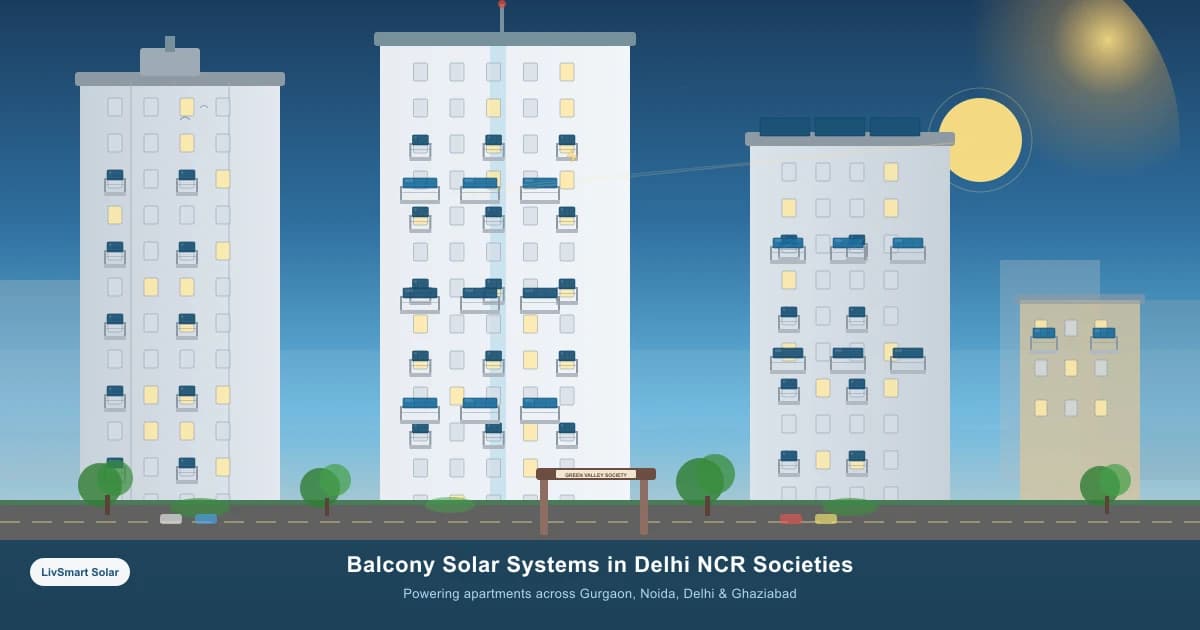
You are not alone. Over 80% of housing in Delhi, Gurgaon, Noida, Ghaziabad, and Faridabad is apartment-based. Rooftop solar requires common-area access and society approval that most residents never get. Balcony solar systems in Delhi NCR solve this problem entirely — compact panels that mount on your balcony railing or terrace wall, generate 800 W to 3 kW of power, and plug into your home's existing wiring. No rooftop. No RWA permission battles. Installed in one to three days.
This guide covers everything: how these systems work, real costs in Indian rupees, monthly savings you can actually expect, DISCOM rules across Delhi NCR, RWA challenges and how to navigate them, and actual examples from societies in Gurgaon and Noida.
What Exactly Is a Balcony Solar System?
A balcony solar system is a compact, plug-and-play solar power unit designed for apartments and flats where rooftop access is not available. Unlike traditional rooftop installations that span 100–300 sq ft, a balcony system fits in 20–60 sq ft — the railing, parapet wall, or a narrow terrace.
Core components
- Solar panels — 2 to 6 Tier-1 monocrystalline modules (each roughly 1.7 m × 1 m), mounted vertically or at an angle on the balcony railing or wall bracket
- Micro-inverter or string inverter — converts DC output to AC power your home appliances use
- Mounting frame — low-penetration or weighted brackets that require zero drilling into the building structure
- Plug-in connection — connects to a standard 15 A socket or a dedicated MCB in your distribution box
- Net meter (optional) — if your DISCOM allows, excess power feeds back to the grid and offsets your bill
The key difference from rooftop solar is portability. Balcony solar panels in India are designed to be unbolted and relocated when you move flats. This makes them ideal for renters and people who shift homes every few years — a reality for a huge portion of Delhi NCR's working population.
How much power does it generate?
| System Size | Panels | Daily Output (Delhi NCR avg.) | Monthly Units | Best For |
|---|---|---|---|---|
| 800 W | 2 panels | 3.2–3.6 kWh | 96–108 units | 1 BHK, lights + fans + Wi-Fi router |
| 1.5 kW | 3–4 panels | 6–6.8 kWh | 180–204 units | 2 BHK, partial AC offset |
| 2 kW | 4–5 panels | 8–9 kWh | 240–270 units | 2–3 BHK, significant AC offset |
| 3 kW | 6 panels | 12–13.5 kWh | 360–405 units | 3 BHK+, most daytime loads covered |
Delhi NCR receives 4.0–4.5 peak sun hours on average, with summer months pushing 5.5+ hours. These estimates assume no heavy shading.
Why Balcony Solar Is Exploding in Delhi NCR
Three forces are driving adoption across the National Capital Region right now.
1. Electricity costs keep rising
Delhi's domestic tariff under BSES and TPDDL crossed ₹8 per unit for higher slabs in 2025. In Gurgaon (DHBVN) and Noida (PVVNL), rates are even steeper — ₹7.50 to ₹9.50 per unit beyond the first 200 units. A typical 3 BHK in Gurgaon running two ACs pays ₹6,000–₹12,000 per month in summer. Shaving even 200–300 units off that bill saves ₹1,500–₹3,000 every month.
2. Apartment density leaves no rooftop option
Gurgaon alone has 800+ high-rise societies. In sectors like 49, 56, 65, 82, and 84 — towers with 200–500 flats share one rooftop that is already occupied by DG sets, water tanks, telecom equipment, and the society's own solar plant (if any). Individual rooftop solar is simply not an option here. The same is true across Greater Noida, Indirapuram, Crossing Republik, and Dwarka.
Balcony solar is the only realistic path to personal solar generation for flat owners in Delhi NCR.
3. Plug-and-play technology has matured
Earlier, apartment solar meant complex wiring, structural modifications, and electrical permits. Modern plug-and-play solar systems in India use micro-inverters with built-in safety shutoffs, anti-islanding protection, and standard plug connections. You do not need an electrician to rewire your flat. The system plugs in, starts generating, and your meter slows down.
How Much Does a Balcony Solar System Cost in Delhi NCR?
Let's talk real numbers — no vague "it depends" answers.
Cost breakdown (2026 prices, installed)
| System Size | Panel Cost | Inverter Cost | Mounting + Wiring | Installation Labour | Total Installed |
|---|---|---|---|---|---|
| 800 W | ₹18,000–₹22,000 | ₹8,000–₹12,000 | ₹4,000–₹6,000 | ₹5,000–₹8,000 | ₹45,000–₹55,000 |
| 1.5 kW | ₹32,000–₹40,000 | ₹12,000–₹18,000 | ₹6,000–₹8,000 | ₹6,000–₹10,000 | ₹70,000–₹90,000 |
| 2 kW | ₹42,000–₹52,000 | ₹15,000–₹22,000 | ₹7,000–₹10,000 | ₹8,000–₹12,000 | ₹85,000–₹1,10,000 |
| 3 kW | ₹60,000–₹78,000 | ₹22,000–₹35,000 | ₹10,000–₹15,000 | ₹10,000–₹15,000 | ₹1,30,000–₹1,70,000 |
Cost per watt: ₹45–₹60 installed (including mounting hardware).
These prices assume Tier-1 panels (Longi, Jinko, Trina, or equivalent) and a quality micro-inverter. Cheaper options exist at ₹35–₹40/watt, but they use lower-grade cells that degrade faster — false economy for a 25-year asset.
What about subsidies?
The central government's PM Surya Ghar Muft Bijli Yojana offers subsidies for rooftop solar — up to ₹30,000 for 1 kW and ₹60,000 for 2 kW systems. However, subsidy disbursement for balcony-mounted (non-rooftop) systems is inconsistent across Delhi NCR DISCOMs. BSES Rajdhani and BSES Yamuna have processed some claims; DHBVN in Gurgaon and PVVNL in Noida have been slower. Check with your installer for the latest status before factoring subsidies into your budget.
ROI and Savings: What Can You Actually Expect?
Here is a realistic calculation for a 1.5 kW balcony solar system in Gurgaon (the most common size we see):
Monthly savings
- Generation: 180–200 units/month (annual average, accounting for monsoon dip)
- Tariff offset: ₹8.50/unit (DHBVN slab for 200–400 unit range)
- Monthly saving: 190 × ₹8.50 = ₹1,615/month
- Summer months (Apr–Sep): Generation rises to 220–250 units → savings of ₹1,870–₹2,125/month
- Annual saving: approximately ₹20,000–₹22,000
Payback period
| Installed Cost | Annual Saving | Payback Period |
|---|---|---|
| ₹80,000 | ₹20,000 | 4 years |
| ₹90,000 | ₹22,000 | 4.1 years |
After payback, you get 21+ years of free electricity (panels carry a 25-year performance warranty). At current tariff escalation rates of 5–7% per year, lifetime savings from a 1.5 kW system cross ₹6–8 lakhs.
For a 3 kW system in a Noida society offsetting ₹3,500–₹4,000/month, payback drops to 3.5–4 years with lifetime savings exceeding ₹12 lakhs.
Legal Rules and DISCOM Policies in Delhi NCR
This is where most apartment owners get confused. Here is a region-by-region breakdown.
Delhi (BSES Rajdhani, BSES Yamuna, TPDDL)
- Net metering: Available for systems up to 500 kW. For residential, typically up to 5 kW per connection.
- Balcony-mounted systems: BSES has approved net metering applications for balcony-mounted systems on a case-by-case basis. TPDDL is more restrictive — primarily accepts rooftop installations.
- Process: Apply through the DISCOM portal → site inspection → meter installation → commissioning certificate.
- Timeline: 30–60 days after application.
Gurgaon and Faridabad (DHBVN — Dakshin Haryana Bijli Vitran Nigam)
- Net metering: Available under Haryana Solar Policy 2024. Systems up to 500 kW.
- Balcony installations: DHBVN does not explicitly differentiate between rooftop and balcony-mounted systems in their policy — as long as the system is connected to your individual meter.
- Key advantage: Gurgaon's DHBVN rates are among the highest in NCR (₹7.50–₹9.50/unit), which means faster ROI.
- Subsidy: PM Surya Ghar portal applications are processed through DHBVN. Approval timelines vary.
Noida, Greater Noida, Ghaziabad (PVVNL — Paschimanchal Vidyut Vitran Nigam)
- Net metering: Available under UP Solar Policy. Systems up to 10 kW for residential.
- Balcony systems: PVVNL typically requires the installation to be fixed (not portable). Wall-mounted and railing-mounted systems qualify.
- Timeline: 45–90 days (UP processes tend to be slower than Delhi or Haryana).
- Tip: If PVVNL net metering is slow, many Noida residents opt for gross metering (sell all power at ₹3–₹4/unit) or simply run the system without net metering and consume all generated power directly.
Can I install without net metering?
Yes. You do not need DISCOM permission to install a solar system. Net metering is only required if you want to export excess power to the grid. Most balcony systems (800 W to 2 kW) generate less than daytime consumption anyway — your fridge, fans, lights, Wi-Fi, and one AC will consume everything the panels produce in real time. This is called self-consumption mode, and it requires zero paperwork.
Installation Process in Delhi NCR Apartments
Here is what a typical installation looks like, start to finish.
Step 1: Site assessment (Day 1)
An installer visits your flat to assess:
- Balcony orientation — South-facing is ideal, east/west still works with 15–20% lower output
- Shading analysis — Nearby towers, trees, overhead structures that block sunlight
- Railing/wall strength — Can it support panel weight (each panel is 20–22 kg)?
- Electrical panel — Capacity of your MCB, earthing quality, meter type
- Usable area — How many panels physically fit
Step 2: System design and quote (Day 2–3)
Based on the assessment, you receive:
- Recommended system size (matched to your bill and balcony area)
- Estimated monthly generation and savings
- Equipment list (panel brand, inverter model, mounting type)
- All-inclusive price with warranty terms
Step 3: Installation (Day 4–7)
- Mounting brackets installed on railing or wall (no drilling into the building's load-bearing structure)
- Panels secured to brackets
- Micro-inverter mounted behind panels or in a weatherproof enclosure
- DC/AC wiring run to your distribution box
- System tested and commissioned
Total disruption: 4–6 hours of actual work. No scaffolding. No crane. No noise complaints from neighbours.
Step 4: Net metering application (optional, Day 7+)
If you want grid export, your installer files the DISCOM application, handles the meter change, and coordinates the inspection. This is a paperwork process — your system can run in self-consumption mode from day one.
RWA Challenges in Delhi NCR Societies — and How to Handle Them
This is the number one concern apartment owners raise. Let's address it directly.
"My RWA won't allow solar panels"
Here is the reality: RWAs cannot legally prohibit you from installing solar panels on your own balcony. Your balcony is part of your exclusive-use area as defined in your sale deed and the apartment buyer's agreement. The RWA governs common areas (rooftop, lobbies, parking), not your private balcony.
That said, societies can set aesthetic guidelines — uniform colours, maximum panel height above the railing, etc. Smart navigation looks like:
- Start with a written request to the RWA, framing it as a "green initiative" that improves the society's ESG credentials
- Reference government policy — mention PM Surya Ghar Yojana and the fact that MNRE actively promotes apartment solar
- Show the installation is non-invasive — no drilling, no structural changes, no wiring through common areas
- Offer a pilot — propose that 3–5 interested residents install first, with the RWA evaluating the outcome before broader adoption
- Get it in writing — once the RWA agrees (even informally), send a follow-up email documenting the approval
"What about the wiring through common areas?"
Modern balcony systems don't need common-area wiring. Everything runs within your flat — panels on your balcony, inverter on your balcony wall or utility area, connection to your own distribution board. No cables in corridors, shafts, or common ducts.
"My society already has rooftop solar — can I still install balcony panels?"
Yes. Your society's rooftop plant is connected to the society's common-area meter. Your balcony system connects to your individual flat meter. They are completely independent. Many societies in DLF Phase 5 (Gurgaon) and Sector 137 (Noida) have both — rooftop solar for common areas and individual balcony systems for residents who want lower personal bills.
Real-World Examples from Delhi NCR
Gurgaon: Ireo Grand Arch, Sector 58
A 3 BHK owner on the 14th floor installed a 2 kW balcony solar system on a south-east facing balcony. Four panels mounted on the railing, micro-inverter behind the panels. Monthly generation: 220–260 units. Monthly saving: ₹1,800–₹2,200. The society had no objection since the panels sit below the railing height and are not visible from the ground.
Noida: ATS Greens, Sector 50
A retired couple in a 2 BHK installed a 1 kW system on their west-facing balcony. Even with the non-ideal orientation, the system generates 100–130 units per month, saving ₹850–₹1,100. They opted out of net metering to avoid the PVVNL paperwork and simply consume all power during daytime.
South Delhi: GK-2, Builder Floor
A second-floor tenant installed a 1.5 kW portable system with weighted floor mounts — no drilling, no wall attachments. When the lease ends, the entire system relocates. Monthly offset: 170–200 units.
Ghaziabad: Crossing Republik
A society of 1,500 flats saw 40+ residents install 800 W to 1.5 kW balcony systems after one resident demonstrated his setup at the society's annual general meeting. The RWA now actively encourages it as a "green society" initiative.
Renters vs. Owners: Which Balcony Solar Setup Is Right?
If you own the flat
- Go for a permanently mounted system with railing brackets
- Apply for net metering (export surplus, maximise savings)
- Choose a higher capacity (2–3 kW) since you will benefit for years
- Factor in the property value increase — solar-equipped flats sell at a 2–4% premium
If you are renting
- Choose a portable, plug-and-play system with weighted floor mounts or clamp brackets
- Stick to 800 W–1.5 kW (easier to move, lower upfront cost)
- Skip net metering — self-consumption mode means zero paperwork
- Ask your landlord for permission in writing (most landlords agree since it does not damage the property)
- The system is your asset — it moves with you to the next flat
This portability factor is why mini solar systems for home in India are gaining traction among the 30–45 age group in Delhi NCR — people who change flats every 2–3 years but want to reduce their electricity costs everywhere they go.
The Future of Balcony Solar in India
Policy tailwinds
The Ministry of New and Renewable Energy (MNRE) explicitly recognizes apartment-based solar under the PM Surya Ghar scheme. As DISCOMs modernize their net metering infrastructure and states harmonize policies, balcony installations will receive the same subsidy and regulatory treatment as rooftop systems — a shift already underway in Delhi.
Technology improvements
Panel efficiency is crossing 23% for standard residential modules. Lighter, thinner panels designed specifically for vertical and railing mounting are entering the Indian market. Battery costs have dropped 40% since 2022, making small home storage (1–3 kWh) viable as an add-on for ₹40,000–₹80,000.
Scale in Delhi NCR
Delhi NCR has an estimated 2.5 million apartment units. If even 10% adopt balcony solar at an average of 1.5 kW per flat, that is 375 MW of distributed solar capacity — equivalent to a medium-sized solar farm, with zero land acquisition. The infrastructure is already in place. The economics already work. The only bottleneck is awareness.
Frequently Asked Questions
Is balcony solar legal in Delhi NCR?
Yes. There is no law in Delhi, Haryana, or Uttar Pradesh that prohibits installing solar panels on your own balcony. The panels are your personal property installed in your exclusive-use area. Net metering requires DISCOM approval, but self-consumption mode needs no permission at all.
How much can I save with a balcony solar panel in India?
A typical 1.5 kW balcony system in Delhi NCR saves ₹1,500–₹2,200 per month depending on your tariff slab, orientation, and shading. Annual savings range from ₹18,000 to ₹26,000 with a payback period of 3.5–4.5 years.
Do I need RWA permission to install solar on my apartment balcony?
Legally, no — your balcony is your exclusive area. Practically, it is wise to inform the RWA and frame it as a green initiative. Most societies in Gurgaon and Noida approve when they see the installation is non-invasive and aesthetically neutral.
Can I install a balcony solar system if I am a tenant?
Absolutely. Plug-and-play solar systems are designed to be portable. Use weighted floor mounts or clamp brackets — no drilling — and take the system with you when you move. Just get written consent from your landlord.
What happens on cloudy or rainy days?
Your system generates 15–30% of its rated output on overcast days. During heavy monsoon months (July–August), expect a 40–50% dip in generation. This is factored into the annual average estimates. Delhi NCR gets 280+ sunny days per year, so the overall impact is manageable.
Ready to Go Solar from Your Balcony?
If you are an apartment owner or tenant in Delhi NCR, a balcony solar system is the most practical, cost-effective way to cut your electricity bill without needing rooftop access, society approvals, or structural modifications. The technology is proven. The economics work. And the installation takes less time than getting a new AC fitted.
Start with a free site assessment — find out exactly how many panels fit your balcony, what your monthly savings will be, and how fast you will break even. Explore balcony solar solutions →
From LivSmart Solar
Ready to install balcony solar?
The Power Spot is our plug-and-play balcony solar kit — installed in 1–3 days, no drilling, no RWA drama. Sized for real Indian apartments.
Stay updated with solar energy insights
Get the latest guides, tips, and news on solar energy delivered straight to your inbox.